Factoidal is an RDF/SPARQL engine whose logic is written as F* specifications and turned into runnable code by extraction, not by hand-writing an implementation that mirrors a spec. This page collects the machinery behind the engine: what "verified" means here, how one source becomes four runtimes, and how the read-write store is structured. For what you can do with your data, start at the home page or the documentation hub.
The parser and the SPARQL algebra are specified in F* and verify
under z3 with no --lax and no escape hatches. Executable code comes
out of fstar.exe --codegen OCaml, so the code you run is derived
from the spec rather than written to match it.
Standing qualifier: parser and algebra spec verified in F*; on-disk backend has unverified OCaml-side optimization layers being migrated back to F*. That boundary is tracked openly in issue #118 and the recovery plan.
The verified-in-F* hub post walks through why F*, what the proofs cover, and what one proof gap looks like when stated plainly.
The same F* source is extracted once and then compiled for several runtimes:
| Target | Output | Status |
|---|---|---|
| Native | bin/<platform>/w3c_runner, bin/<platform>/factoidal |
full W3C pass counts |
| JavaScript (js_of_ocaml) | /fstar-extracted/w3c-runner.js |
runs in any modern browser or Node |
| WebAssembly (wasm_of_ocaml) | /fstar-extracted/w3c-runner.wasm.js + .wasm.assets/ |
Wasm-GC engines (Chrome ≥ 119, Node ≥ 22); experimental — cross-runtime parity tracked in tests/beyond-w3c/ |
| C (KaRaMeL) | native C from the same spec | pilot; see the C-build plan |
The artifacts are rebuilt by CI on every push and ship from
docs/fstar-extracted/. The Wasm binary links a vendored copy of
zarith_stubs_js's
runtime.wat + runtime_wasm.js to wire the ml_z_*
arbitrary-precision integer primitives through to JavaScript BigInt.
The hash builtins (MD5/SHA family) are realised in pure OCaml
(fstar_pure_hashes.ml) so native, JS, and Wasm builds share one code
path — the historical functions-suite Wasm gap came from C hash
stubs and no longer applies.
F* formal spec  (the product)
    |
    v
fstar.exe --codegen OCaml
    |
    ├── ocamlfind ocamlc     → bin/<platform>/w3c_runner      (native)
    ├── js_of_ocaml          → docs/fstar-extracted/w3c-runner.js
    └── wasm_of_ocaml        → docs/fstar-extracted/w3c-runner.wasm.{js,assets/}
See
formal/fstar/build-ocaml.sh
for the exact invocation.
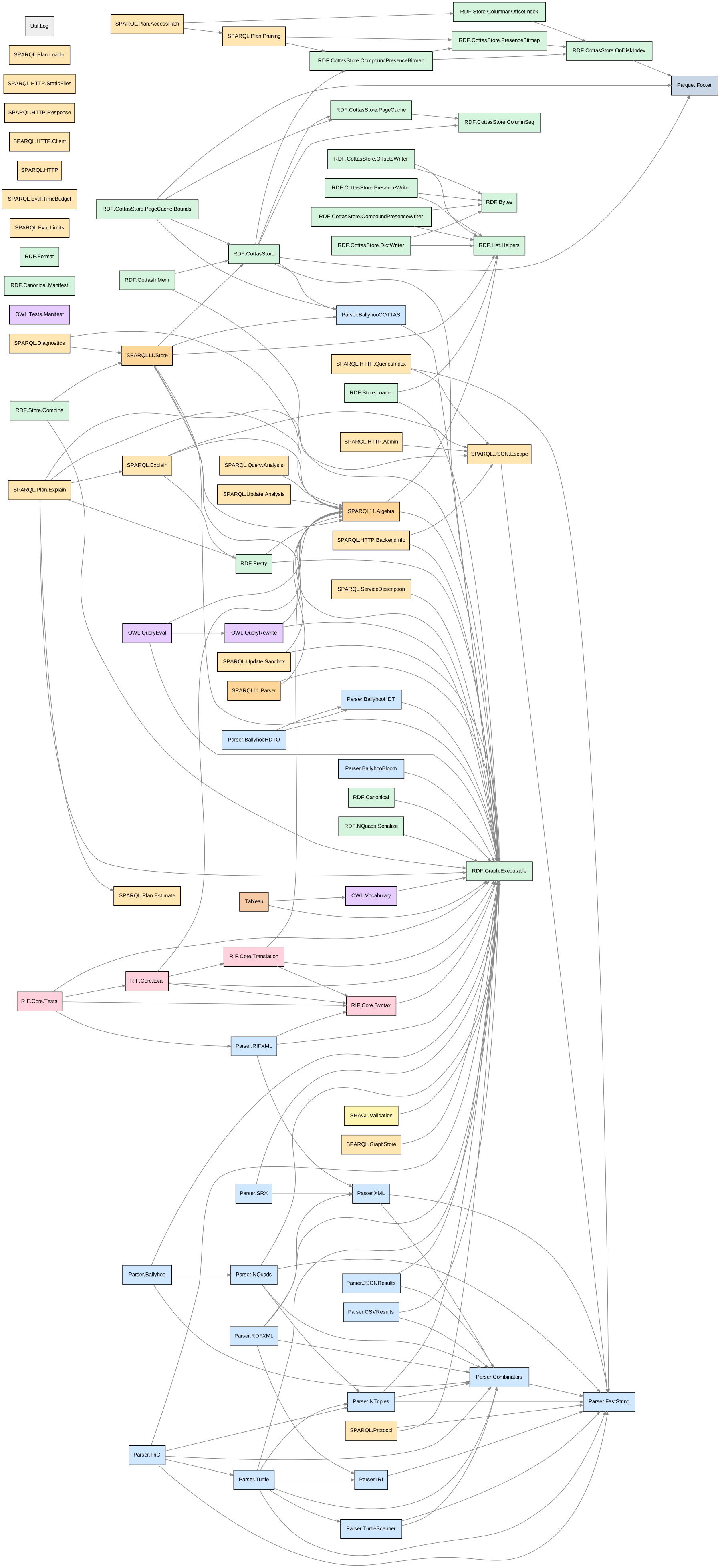
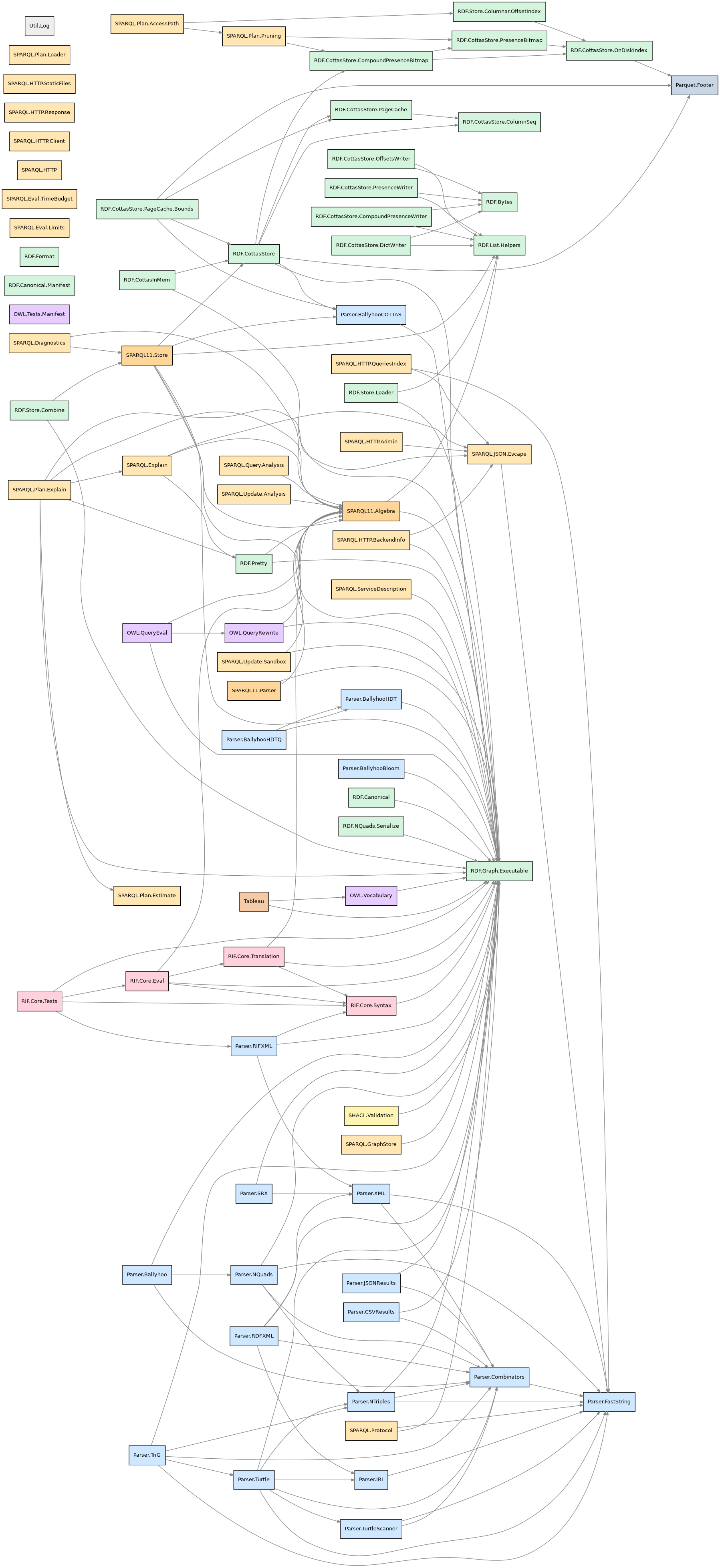
The F* spec is split across 90 modules. The
interactive dependency graph
shows what depends on what — derived from fstar.exe --dep graph so
the edges match what the build sees. Static
SVG /
PNG /
Graphviz /
Mermaid /
plain-text renders are
shipped alongside.
The on-disk store accepts SPARQL UPDATE and the Graph Store Protocol
over HTTP (factoidal-http --rw), backed by an immutable COTTAS base
plus an append-only delta log with framing round-trips proved in F*.
Readers merge the log on read (the merge lemma is proved, not
asserted); compaction swaps in a new base atomically via a symlink,
guarded by an epoch check. Crash-safety is measured, not claimed:
SIGKILL harnesses at every write stage accept zero torn or corrupt
states. The store lifecycle is self-contained — factoidal import
writes COTTAS natively (byte-compatible with DuckDB's Parquet reader),
so no Python or third-party tooling is needed to create, update,
compact, or serve a database.
The same delta-log write path runs on native OCaml, KaRaMeL-extracted
C (bd9e5be),
and js_of_ocaml / wasm_of_ocaml in the browser, where the log
persists in IndexedDB across page reloads
(8ff60eb).
The durable-log hub post
runs the whole cycle — update, persist, reload, corrupt, recover —
live in the page.
On-disk fast paths still include unverified OCaml optimization layers being migrated back to F*; the parser and algebra spec are verified, and that boundary is tracked openly.
Speed is measured separately from correctness — each number names its date and the commit it was measured on.
| What | Measured | Date / commit |
|---|---|---|
| Turtle parsing | ~100k triples/s, near-linear to 1M triples (1M in 9.66s) | 2026-07-03, 11ba254 |
| In-memory dataset, end-to-end (parse + index + GRAPH-count query) | 1M quads in ~41s, ~1.2 GB peak RSS (~1.2 KB/quad) | 2026-07-03, bef4e4b |
In-memory COTTAS-bytes store (--data-cottas-mem) |
64.4 B/quad for a full-corpus COUNT, 160.9 B/quad for point lookups — vs 877 B/quad on the heap store | 2026-07-06, 677bdf1 |
| OWL-RL closure, sameAs 32-clique (was >590s cap-trip) | 1.07s — closure step reduced from O(k⁶) to ~O(k³) | 2026-07-03, 4812c3d |
| On-disk COTTAS | serves the 3,143,406-quad UK Parliament corpus (live demo); fast paths still unverified OCaml being migrated to F* | issue #118 |
How the four extraction targets (native OCaml, js_of_ocaml, wasm_of_ocaml, KaRaMeL C) compare on the same work — including whether the C pathway could yield a faster wasm — is measured on the performance hub.